Article on hydroMOPSO R package published in EMS

On January 2nd, 2026, Environmental Modelling & Software (EMS) published our article entitled hydroMOPSO: A flexible and model-independent multi-objective optimisation R package for environmental and hydrological models. This study introduces hydroMOPSO, a multi-objective, model-independent R package for the calibration of hydrological and environmental models.
Motivation
Environmental and hydrological models are widely used to support decisions on water management, flood forecasting, and climate change adaptation. A critical step in building trustworthy models is calibration, the process of adjusting model parameters so that simulations reproduce observed conditions.
Traditionally, calibration has relied on optimizing a single performance metric. While straightforward, this approach can overlook important trade-offs among different processes—such as reproducing both floods and droughts—and can lead to multiple parameter sets producing similar results, reducing confidence in model predictions.
What is novel in hydroMOPSO
hydroMOPSO is an open-source R package designed to calibrate models using multi-objective optimisation. Instead of searching for a single best solution, hydroMOPSO is able to evaluate several performance criteria simultaneously, to and identify a set of solutions that balance the competing objectives. This provides a more comprehensive view of model behavior and improves the robustness of calibration outcomes.
A central design feature of the tool is its model independence, i.e., it can be used with:
-
Models written directly in R.
-
External models executed from the command line (for example, hydrological or groundwater models).
This flexibility allows users to apply advanced optimization techniques without modifying the original model code. The package also supports parallel computing, which can substantially reduce calibration time for computationally demanding applications.
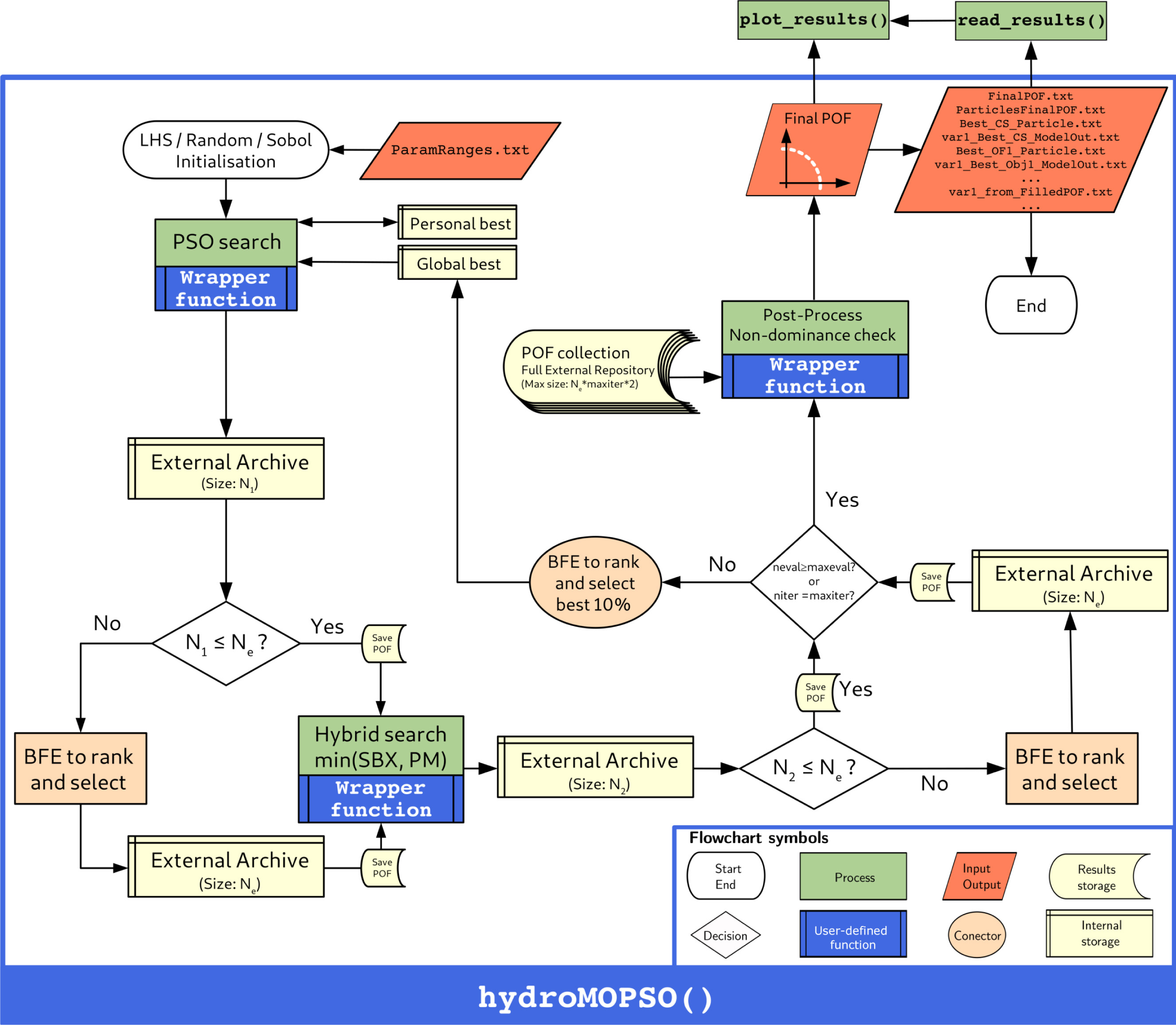
Flowchart illustrating the interaction between the main hydroMOPSO functions, from the initial PSO and hybrid search to the update of the global best
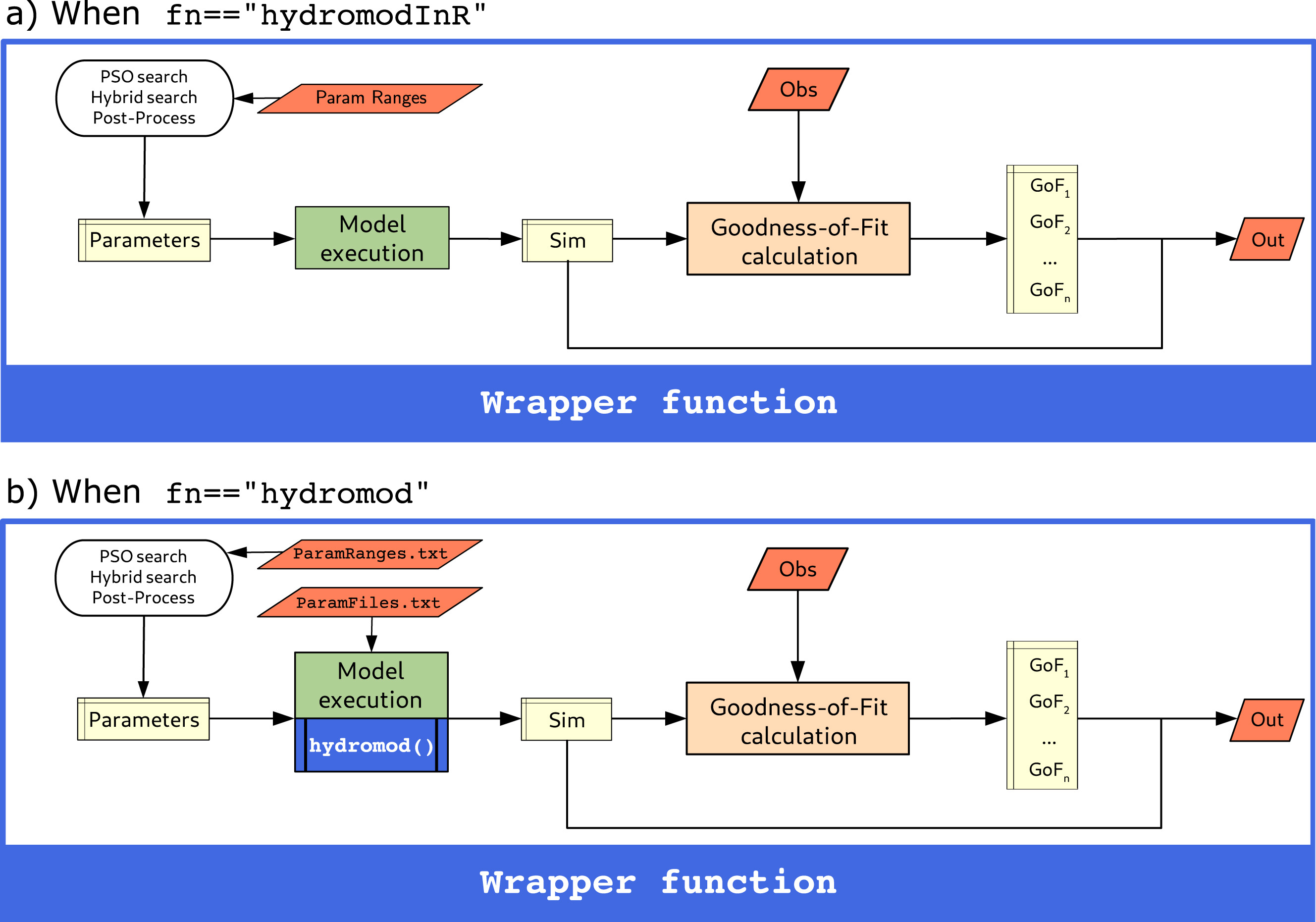
Flowchart illustrating the wrapper function required to run hydroMOPSO.
What the study demonstrated
We evaluated hydroMOPSO using both standard mathematical benachmark problems and real hydrological case studies. Across these tests, the method showed consistent advantages:
-
Improved search efficiency: The algorithm reached high-quality solutions more rapidly than an established alternative approach.
-
Better representation of trade-offs: In practical hydrological applications, the method more effectively identified the range of optimal compromises between conflicting objectives, such as matching peak flows while maintaining realistic low-flow behavior.
-
Operational usability: The software automatically highlights a Best Compromise Solution, helping users select a practical parameter set from among multiple optimal options.
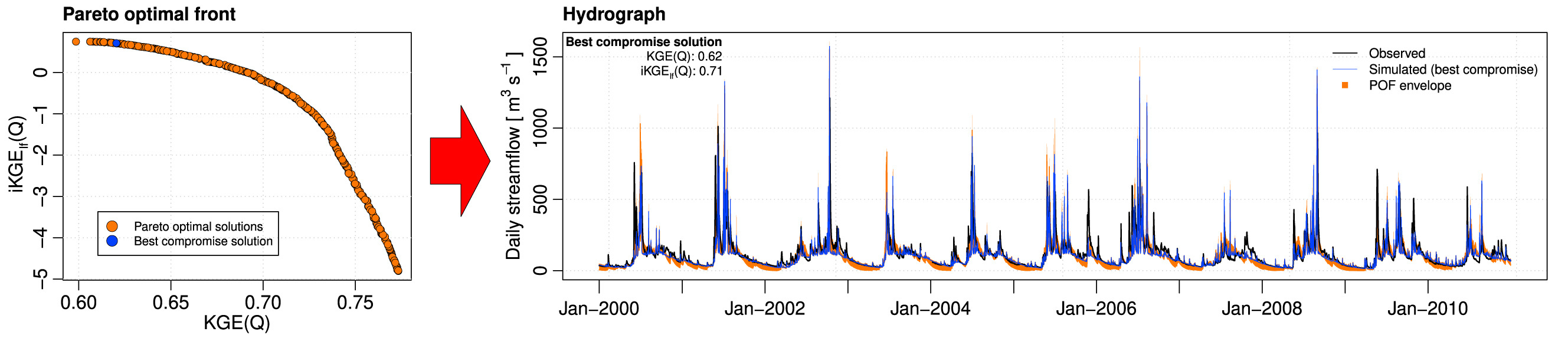
Results of the R-external model calibration using SWAT+.
Why this is important for applied modelling
Multi-objective calibration methods are often perceived as complex to implement and interpret. This work demonstrates that such approaches can be integrated into routine modelling workflows using accessible, open-source tools. By improving calibration transparency and efficiency, the framework supports more credible simulations for water resources planning, environmental assessment, and risk management.
The package is publicly distributed through the CRAN, ensuring open access, reproducibility, and long-term availability for the modelling community.
The full article can be found here: https://doi.org/10.1016/j.envsoft.2025.106851.

I am an Associate Professor in the Department of Civil Engineering at the University of La Frontera. I hold a PhD in Environmental Engineering from the University of Trento (Italy) and completed postdoctoral training at the European Commission’s Joint Research Centre. I have more than 20 years of experience in water resources research and have previously served as an Associate Researcher at the Center for Climate and Resilience Research (CR)2 and as a member of the Earth Sciences Assessment Group of the Chilean National Research and Development Agency (ANID).
My research lies at the interface of hydrology, data science, and environmental sciences, with a particular focus on the use of gridded datasets and open-source tools to investigate droughts, extreme events, and water-related impacts of global change.
I work across spatial and temporal scales to improve the understanding of catchment-scale hydrological processes and to translate this knowledge into operational modelling, forecasting, and early-warning systems that support robust environmental decision-making.
Please reach out to collaborate 😃