Hottest July on Record (174 years), (NASA)

Earth just roasted under its hottest July on record, according to scientists from NOAA’s National Centers for Environmental Information (NCEI) and also ffrom scientist from NASA.
For the fourth-consecutive month, the global ocean surface temperature also hit a record high.
Overall, July 2023 was 0.24ºC warmer than any other July in NASA’s record (since 1880), and it was 1.18ºC warmer than the average July between 1951 and 1980.
Parts of South America, North Africa, North America, and the Antarctic Peninsula were especially hot, experiencing temperatures increases around 4ºC above average. Overall, extreme heat this summer put tens of millions of people under heat warnings and was linked to hundreds of heat-related illnesses and deaths. The record-breaking July continues a long-term trend of human-driven warming driven primarily by greenhouse gas emissions that has become evident over the past four decades. According to NASA data, the five hottest Julys since 1880 have all happened in the past five years.
“Climate change is impacting people and ecosystems around the world, and we expect many of these impacts to escalate with continued warming” said Katherine Calvin, chief scientist and senior climate advisor at NASA Headquarters in Washington. “Our agency observes climate change, its impacts, and its drivers, like greenhouse gases, and we are committed providing this information to help people plan for the future.”.
For more information please visit:
- NASA Clocks July 2023 as Hottest Month on Record Ever Since 1880
- Record shattering: Earth had its hottest July in 174 years
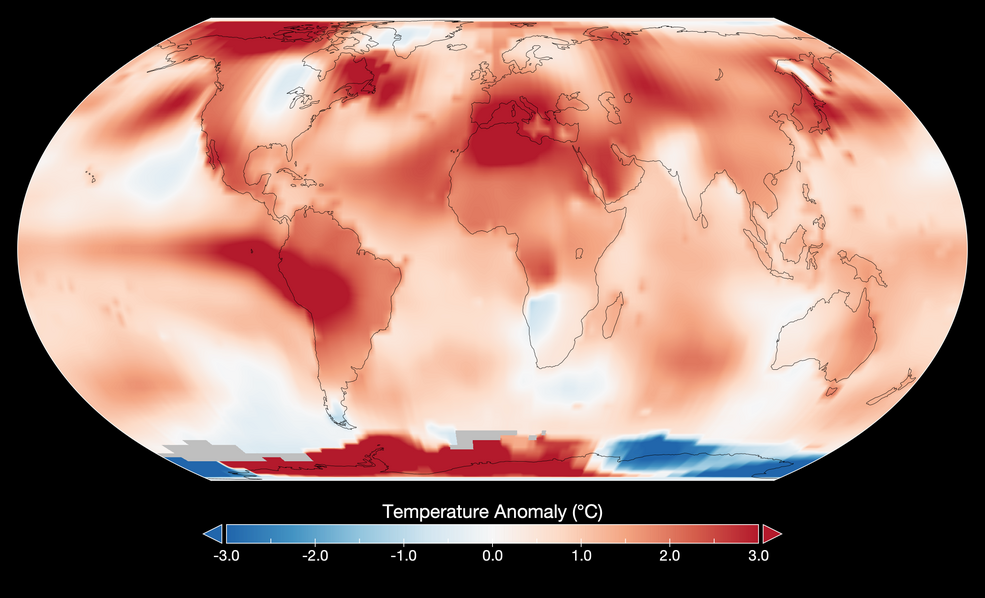
This map shows global temperature anomalies for July 2023 according to the GISTEMP analysis by scientists at NASA’s Goddard Institute for Space Studies. Temperature anomalies reflect how July 2023 compared to the average July temperature from 1951-1980.Credits: NASA’s Goddard Institute for Space Studies

I am an Associate Professor in the Department of Civil Engineering at the University of La Frontera. I hold a PhD in Environmental Engineering from the University of Trento (Italy) and completed postdoctoral training at the European Commission’s Joint Research Centre. I have more than 20 years of experience in water resources research and have previously served as an Associate Researcher at the Center for Climate and Resilience Research (CR)2 and as a member of the Earth Sciences Assessment Group of the Chilean National Research and Development Agency (ANID).
My research lies at the interface of hydrology, data science, and environmental sciences, with a particular focus on the use of gridded datasets and open-source tools to investigate droughts, extreme events, and water-related impacts of global change.
I work across spatial and temporal scales to improve the understanding of catchment-scale hydrological processes and to translate this knowledge into operational modelling, forecasting, and early-warning systems that support robust environmental decision-making.
Please reach out to collaborate 😃