WMO confirms 2024 as warmest year on record at about 1.55°C above pre-industrial level

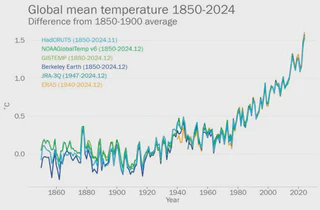
The World Meteorological Organization (WMO) has released a consolidated report confirming that 2024 was the warmest calendar year on record. By synthesizing six leading international datasets, the WMO provides a high-confidence assessment of global thermal anomalies, the state of oceanic heat reservoirs, and the current standing of international climate targets.
1. Temperature anomalies and statistical significance
The global mean surface temperature in 2024 was calculated at $1.55 \text{°C}$ above the 1850–1900 pre-industrial baseline, with a margin of uncertainty of $\pm 0.13 \text{°C}$. This marks the first time a single calendar year has likely exceeded the 1.5°C threshold.
To ensure authoritative results, the WMO integrated data from the following institutions:
-
Atmospheric/Satellite Agencies: ECMWF (Europe), Japan Meteorological Agency, NASA (USA).
-
Surface Instrumental Records: NOAA (USA), Berkeley Earth, and the UK Met Office (HadCRUT).
While all six datasets identified 2024 as the warmest year, slight methodological variations mean that not every individual agency placed the anomaly above 1.5°C. However, the consolidated mean provides a robust signal of unprecedented global heating.
2. The Paris agreement vs. annual spikes
A critical technical distinction made in the report concerns the Paris Agreement. WMO experts clarify that a single-year breach of 1.5°C does not constitute a failure to meet the treaty’s long-term goals. The Paris Agreement targets are measured over multi-decadal averages (typically 20–30 years).
- Current Long-Term Warming: As of 2024, the assessed long-term global warming trend stands at approximately 1.3°C above the baseline.
- Transient Forcing: The 2024 spike was amplified by a strong El Niño event that persisted from mid-2023 through May 2024.
Despite this distinction, WMO Secretary-General Celeste Saulo emphasized that every fraction of a degree matters, as incremental increases correlate directly with the frequency and intensity of extreme weather events, cryosphere loss, and sea-level rise.
3. Marine thermodynamics and Ocean Heat Content (OHC)
While surface temperatures capture public attention, the report highlights that 90% of excess heat from anthropogenic warming is absorbed by the oceans. A study in Advances in Atmospheric Sciences cited by the WMO indicates that ocean temperatures have reached record highs in both surface and sub-surface layers (down to 2,000 meters).
Energy Benchmark: Between 2023 and 2024, the upper 2,000 meters of the ocean gained 16 Zettajoules ($10^{21}$ Joules) of heat. For context, this energy increase is approximately 140 times the total global electricity generation for the year 2023.
This massive thermal inertia in the marine system ensures that sea-level rise and glacier retreat will continue for centuries, regardless of short-term surface temperature fluctuations.
4. Policy implications and future monitoring
UN Secretary-General António Guterres utilized the report to call for trail-blazing climate action, urging governments to submit revised national climate action plans. The data serves as a technical foundation for the UN Climate Change negotiating process, providing the empirical evidence required for global decarbonization strategies. The WMO will release a comprehensive “State of the Global Climate 2024” report in March 2025, detailing further indicators such as greenhouse gas concentrations and sea-ice extent.
For more information please visit:
-
WMO confirms 2024 as warmest year on record at about 1.55°C above pre-industrial level
-
Temperatures Rising: NASA Confirms 2024 Warmest Year on Record
-
Xie, SP., Miyamoto, A., Zhang, P. et al. What made 2023 and 2024 the hottest years in a row?. npj Clim Atmos Sci 8, 117 (2025). https://doi.org/10.1038/s41612-025-01006-y
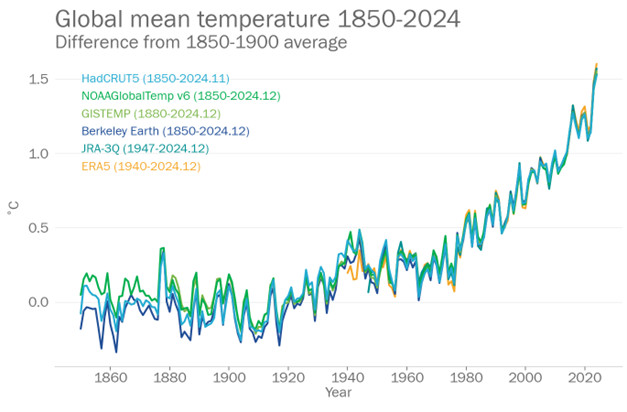
“Today’s assessment from the World Meteorological Organization (WMO) proves yet again – global heating is a cold, hard fact,” said UN Secretary-General Antóno Guterres. Source: WMO

I am an Associate Professor in the Department of Civil Engineering at the University of La Frontera. I hold a PhD in Environmental Engineering from the University of Trento (Italy) and completed postdoctoral training at the European Commission’s Joint Research Centre. I have more than 20 years of experience in water resources research and have previously served as an Associate Researcher at the Center for Climate and Resilience Research (CR)2 and as a member of the Earth Sciences Assessment Group of the Chilean National Research and Development Agency (ANID).
My research lies at the interface of hydrology, data science, and environmental sciences, with a particular focus on the use of gridded datasets and open-source tools to investigate droughts, extreme events, and water-related impacts of global change.
I work across spatial and temporal scales to improve the understanding of catchment-scale hydrological processes and to translate this knowledge into operational modelling, forecasting, and early-warning systems that support robust environmental decision-making.
Please reach out to collaborate 😃