Earth just had its hottest June on record (NOAA)

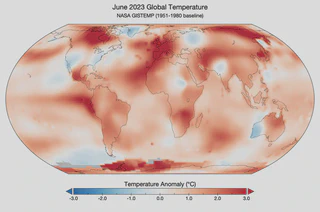
The world just sweltered through its hottest June in the 174-year global climate record.
The June global surface temperature was 1.05°C above the 20th-century average of 15.5°C, making it the warmest June on record. This marked the first time a June temperature exceeded 1°C above the long-term average.
June 2023 was 0.13°C warmer than the previous June record from 2020, but 0.29°C cooler than the all-time highest monthly temperature anomaly on record (March 2016).
June 2023 marked the 47th consecutive June and the 532nd consecutive month with temperatures at least nominally above the 20th-century average.
Additionally, Earth’s ocean surface temperature anomaly, which indicates how much warmer or cooler temperatures are from the long-term average, were the highest ever recorded and the sea ice coverage hit a record low, according to scientists from NOAA’s National Centers for Environmental Information.
For more information please visit:
- Earth just had its hottest June on record
- June 2023 was the hottest June on record according to NASA’s global temperature analysis
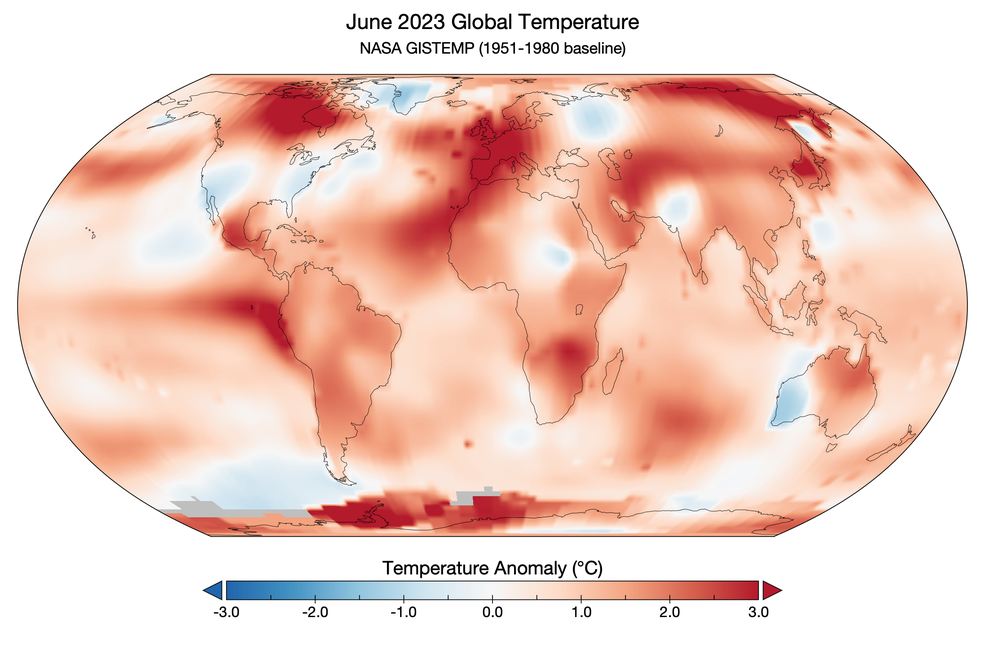
This map shows global temperature anomalies for June 2023 according to the GISTEMP analysis by scientists at NASA’s Goddard Institute for Space Studies. Temperature anomalies reflect how June 2023 compared to the average June temperature from 1951-1980. Credits: NASA’s Goddard Institute for Space Studies

I am an Associate Professor in the Department of Civil Engineering at the University of La Frontera. I hold a PhD in Environmental Engineering from the University of Trento (Italy) and completed postdoctoral training at the European Commission’s Joint Research Centre. I have more than 20 years of experience in water resources research and have previously served as an Associate Researcher at the Center for Climate and Resilience Research (CR)2 and as a member of the Earth Sciences Assessment Group of the Chilean National Research and Development Agency (ANID).
My research lies at the interface of hydrology, data science, and environmental sciences, with a particular focus on the use of gridded datasets and open-source tools to investigate droughts, extreme events, and water-related impacts of global change.
I work across spatial and temporal scales to improve the understanding of catchment-scale hydrological processes and to translate this knowledge into operational modelling, forecasting, and early-warning systems that support robust environmental decision-making.
Please reach out to collaborate 😃