The Past 3 Years Have Been the Three Hottest

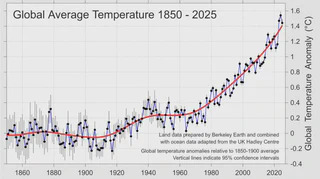
The recent analysis published by Berkeley Earth, corroborated by the National Oceanic and Atmospheric Administration (NOAA), confirms that 2025 was the third-warmest year on record. This year follows 2024 and 2023, collectively forming a three-year “warming spike” that deviates significantly from long-term linear trends and poses critical questions regarding the acceleration of anthropogenic climate change.
Statistical Overview and Record Benchmarks
In 2025, global average temperatures were estimated to be between 1.35°C and 1.53°C above the 1850–1900 pre-industrial baseline. While slightly lower than the peaks seen in 2024 ($1.46\text{--}1.62\text{°C}$) and 2023 ($1.48\text{--}1.60\text{°C}$), the data underscores a persistent breach of, or proximity to, the 1.5°C threshold established by the Paris Agreement.
NOAA-NCEI’s independent methodology, which utilizes a 20th-century average as its benchmark, reached a consistent conclusion, placing 2025 at 1.17°C above that mean. This inter-agency consensus reinforces the reliability of current global thermometry despite varying analytical frameworks.
Dynamics of the “warming spike”
Chief Scientist Robert Rohde and other researchers suggest that the 2023–2025 period represents a potential shift in climate velocity. The magnitude of this spike exceeds what is typically attributed to greenhouse gas (GHG) forcing and internal natural variability alone. Several exogenous and feedback factors are under investigation:
-
Aerosol Forcing: Post-2020 regulations reducing sulfur emissions from maritime shipping have inadvertently decreased the “parasol effect,” where sulfate aerosols reflect incoming solar radiation.
-
Volcanic Forcing: The 2022 Hunga Tonga-Hunga Ha’apai eruption injected massive quantities of water vapor (a potent GHG) into the stratosphere, though its precise radiative forcing impact is still being quantified.
-
ENSO Transitions: While 2023 and 2024 were amplified by a strong El Niño, 2025 saw a transition to weak La Niña conditions. Typically, La Niña exerts a cooling influence; the fact that 2025 remained the third-hottest year despite this suggests that the underlying warming signal is increasingly dominant.
Sociopolitical and regional impacts
The human cost of this thermal trend is concentrated: in 2025, approximately 770 million people, primarily in Asia, experienced their hottest local year on record. Notably, no region on Earth recorded a record-cold year, highlighting the global scale of the imbalance.
Furthermore, data from the Rhodium Group indicates a 2.4% increase in U.S. greenhouse gas emissions in 2025, complicating international mitigation efforts. As the U.S. recorded its fourth-hottest year, the disconnect between climate reality and emissions trajectories remains a primary concern for policymakers.
Future projections
Berkeley Earth projects that 2026 will likely be the fourth-warmest year on record. The transition of the 2023–2025 spike from an anomaly into a potential new “baseline” suggests that historical warming rates may no longer serve as reliable predictors for future climate modeling. This underscores the urgent need for robust, open-source climate data to inform evidence-based adaptation and mitigation strategies.
For more information please visit:
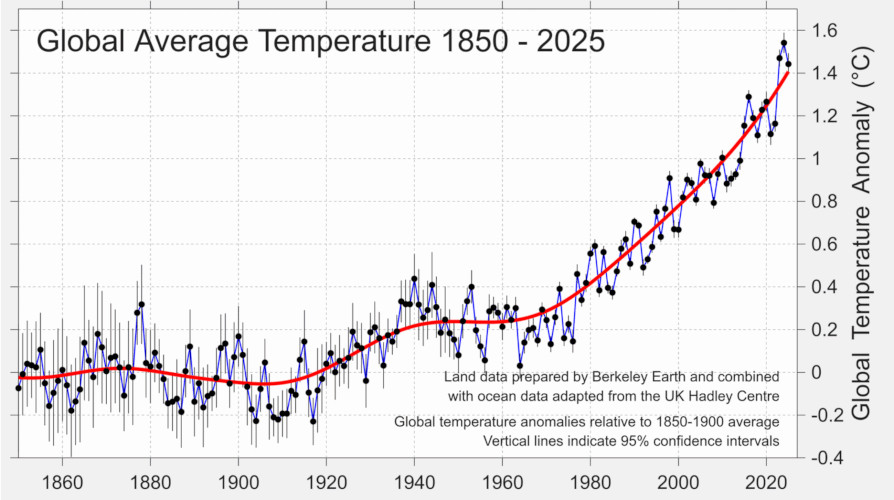
Scientists say the exceptional warming observed in the past 3 years could be evidence of accelerating warming. Credit: Berkeley Earth, CC BY-NC 4.0

I am an Associate Professor in the Department of Civil Engineering at the University of La Frontera. I hold a PhD in Environmental Engineering from the University of Trento (Italy) and completed postdoctoral training at the European Commission’s Joint Research Centre. I have more than 20 years of experience in water resources research and have previously served as an Associate Researcher at the Center for Climate and Resilience Research (CR)2 and as a member of the Earth Sciences Assessment Group of the Chilean National Research and Development Agency (ANID).
My research lies at the interface of hydrology, data science, and environmental sciences, with a particular focus on the use of gridded datasets and open-source tools to investigate droughts, extreme events, and water-related impacts of global change.
I work across spatial and temporal scales to improve the understanding of catchment-scale hydrological processes and to translate this knowledge into operational modelling, forecasting, and early-warning systems that support robust environmental decision-making.
Please reach out to collaborate 😃