
SICyR_2025
by Mauricio Zambrano-Bigiarini
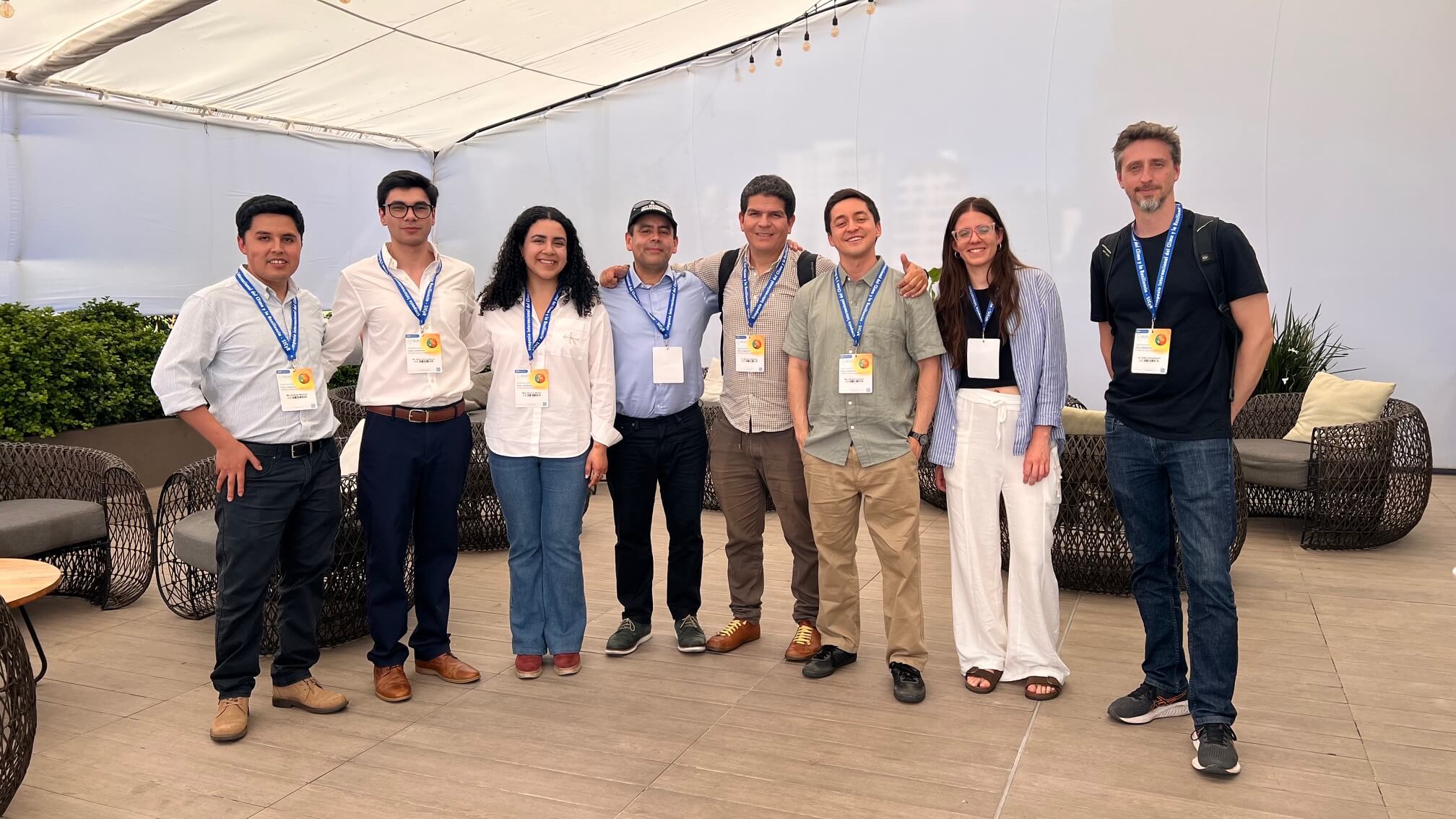
Members of the Kimün-Ko Water Resources Observatory participated in the International Symposium on Climate and Resilience: The Future Becomes Present, an event that brought together leading researchers, academics, and professionals from the social and natural sciences. The symposium took place on November 3-4 in Santiago, where the plenary sessions and workshops were held, and continued from November 5-7 in Viña del Mar, where the thematic scientific sessions took place.
R Course: Spatiotemporal Data Analysis
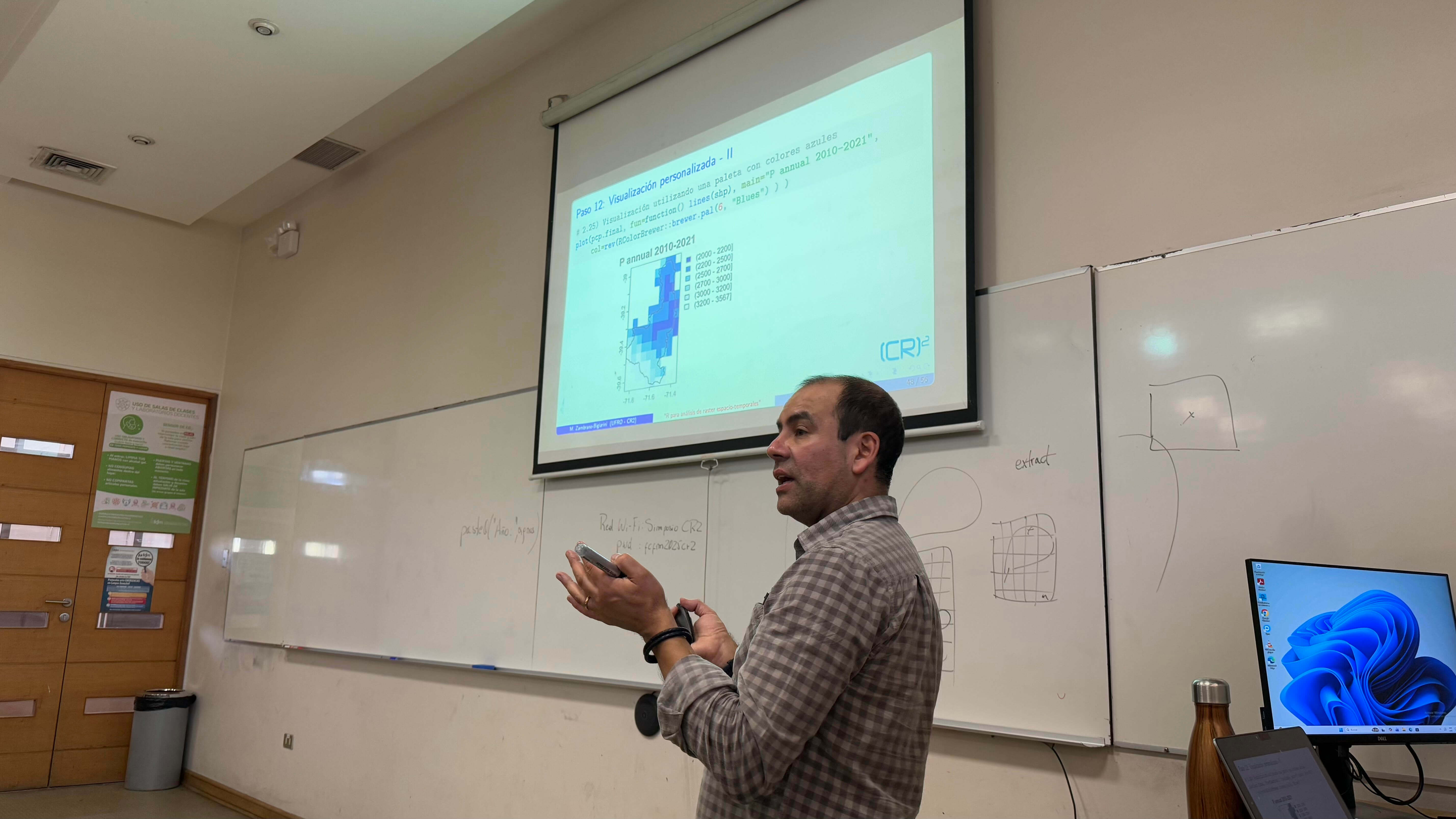
On November 4, I taught the course Using R for Spatiotemporal Data Analysis: Application to Precipitation from CR2Met2.5, which was attended by undergraduate and graduate students, as well as public and private sector professionals.
Scientific Sessions
Between November 5th and 7th, I organized two thematic sessions. The first, HC7. Droughts: Monitoring, Propagation, and Impacts in a Changing Climate, was co-organized by Dr. Pablo Spennemann, an Argentinian researcher with whom I have maintained an active collaboration since the SISSA Webinar Series, an initiative aimed at strengthening scientific exchange on drought in South America. The second session was HC2. Hydrological Processes in a Changing Climate, which I co-organized with Dr. Mauricio Galleguillos from Adolfo Ibáñez University, fostering interdisciplinary dialogue on hydrological processes in a changing climate context.
Furthermore, I gave an oral presentation titled “Understanding soil memory: how antecedent moisture modulates streamflow responses to precipitation events,” a collaborative work with Dr. Oscar Báez-Villanueva (University of Ghent, Belgium), Dr. Violeta Tolorza (formerly of UFRO), and student Héctor Garcés-Figueroa. This study addresses the influence of antecedent soil moisture on the hydrological response to precipitation events and is part of the Fondecyt Regular Project No. 1212071.
Similarly, some members of the Kimün-Ko Water Resources Observatory presented the following work:
-
Héctor Garcés-Figueroa, a research assistant on the Fondecyt Regular project 1212071, gave an oral presentation on the work “Ahead of the Flood: Medium-Range Hydrological Forecasting for Southern Chilean Catchments” which explores the use of medium-range hydrological forecasts to improve flood anticipation in basins in southern Chile. He also co-authored the presentation by Dr. Zambrano-Bigiarini.
-
Rocío Muñoz, a member of the Observatory and a Civil Engineer from the University of La Frontera, presented a poster titled “Operational Monitoring of Soil Moisture Anomalies for Continental Chile”. This work makes a significant contribution to the development of tools for monitoring and analyzing soil moisture at a national scale, and is part of his doctoral thesis project.
-
Fernando Gimeno Molina, a doctoral candidate in the Doctoral Program in Natural Resources Sciences at the University of La Frontera, presented his research in poster format, titled “Soil Mapping Matters: Changes in High Streamflow Simulations through Spatial Soil Information”. His study highlighted the relevance of spatial soil information in modeling high-flow events, a key issue for flood risk management.
The presentations by the Kimün-Ko team generated considerable interest among the attendees, receiving positive and insightful feedback from researchers at various national and international universities. The quality of the work, along with the approach applied to the current challenges of climate change and water resource management, was widely recognized by the scientific community.
The Observatory’s participation in this symposium reaffirms its commitment to cutting-edge research and interdisciplinary collaboration, contributing relevant knowledge to build a more resilient society in the face of the impacts of climate change.
Drought Propagation
Finally, this international symposium allowed me to meet for the first time with Dr. Pablo Spennemann, an Argentinian researcher with whom I am investigating the mechanisms and timescales that control drought propagation in four Chilean river basins (Petorca, Mapocho, Cauquenes, and Trancura), from precipitation deficits to decreased soil moisture and flow rates, and the impact on vegetation.
Subscribe via RSS
